


A twisted Punk love story for society’s outcasts, Guadagnino brings us two misfits who hunger for belonging in the beautiful “Bones and All”.
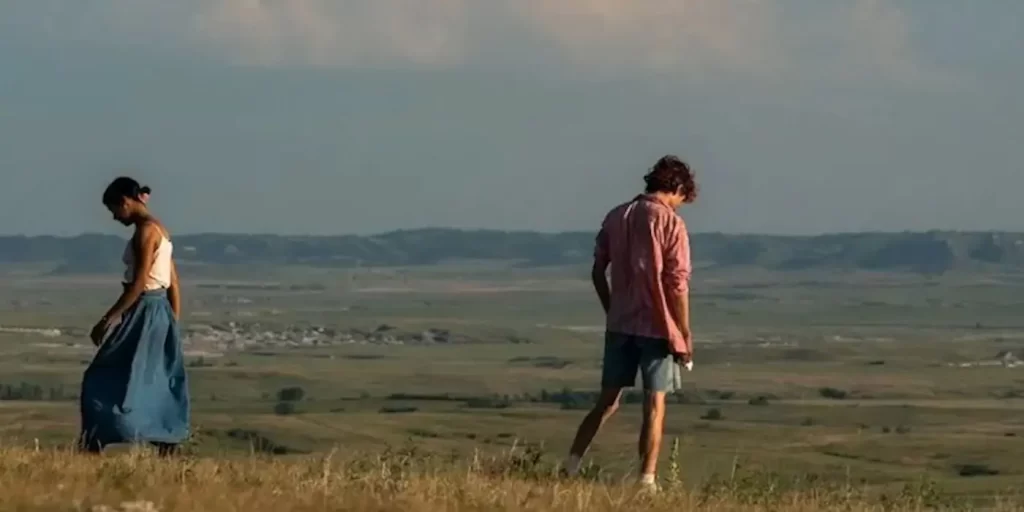
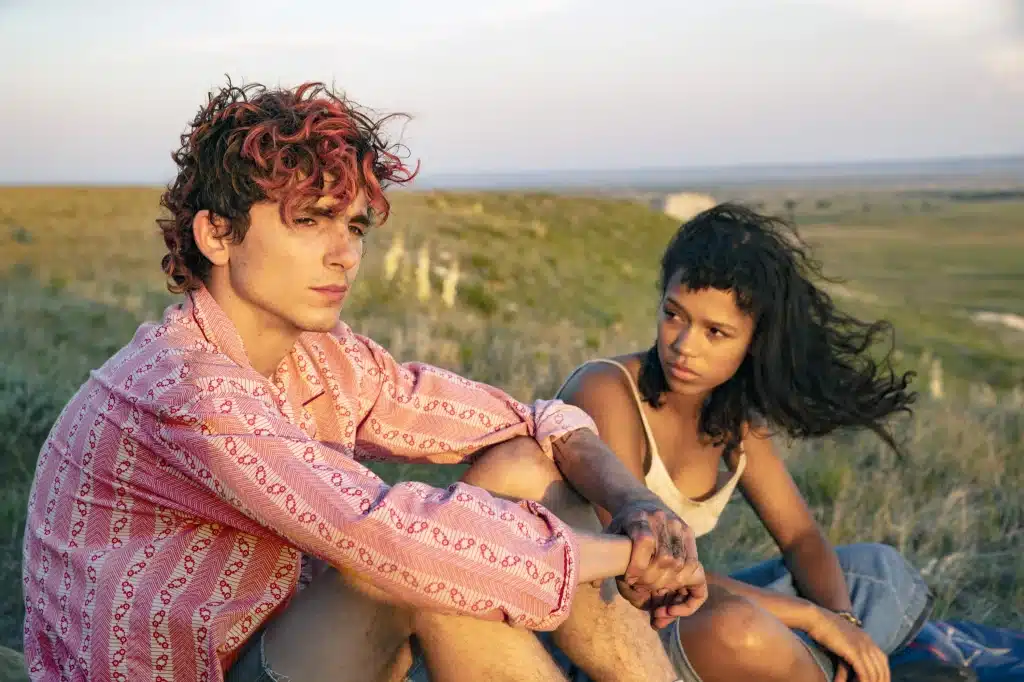
Bones and All is Luca Guadagnino’s (Suspiria 2018) second Horror feature, based on the novel of the same name by Camille DeAngelis. It stars Timothee Chalamet as Lee, a young drifter from a broken home, and Taylor Russell as Maren, a teen fending for herself after being abandoned by her father.
The story is told from Maren’s perspective, and we gain insight into how her relationship with her father broke down from an audio tape that he recorded and left for her to find after fleeing their home forever.
Filmed on 35mm Kodak film, the cinematography by Arseni Khachaturan lends a nostalgic air reminiscent of those intimate Polaroid snaps taken in photobooths inside malls. The sweeping, sprawling landscapes of America’s Midwest fill the screen, encapsulated by a heart-wrenching original score from Trent Reznor & Atticus Ross, which lends an otherworldly feel to this road movie.
90’s grungy youngsters hold hands from the seats of pickup trucks as the opening notes of Joy Division’s Atmosphere booms before opening onto a night-time fairground scene evoking a strong longing for times and youth long-since spent.
Both the cinematography and the score contribute to how audiences will emotionally connect with this film. However, the utter lack of love shown to Maren and Lee throughout their young lives meant that I deeply empathized with them despite their questionable choices at times.
At its bare bones, this is a story of two broken people finding love in one another even though life has taught them that they are truly unlovable.

We experience the story through Maren as she comes to terms with her recent abandonment; her father can no longer tolerate her grisly baser instincts, having fought so hard to control them for much of her life.
Maren’s experience serves as a euphemism for the rejection faced by so many children from their parents. The symbolism of no longer loving a child because of how their Trauma manifests in their troubling behaviors is a trope that is sadly experienced by many neglected youngsters universally.
This metaphor is also applicable to the hatred that many LGBTQ+ youngsters experience from their own families when they finally come out.
This deep-rooted shame also seeps into the sexual encounters Lee has with strange men; he shows zero enthusiasm or lust until it is time to feed.
Lee and Maren are ‘Eaters’: a group or race of people who must consume human flesh to survive and thrive. It is implied that these cannibals feel the uncontrollable urge to consume people who they are physically attracted to/ feel affection towards.
Maren’s ‘Eater’ behaviors are first exposed to the audience during a scene that is darkly funny yet unbearably tense all at once. This is the only moment of humor in the entire film.
Guadagnino instead focuses on the grim reality of living with such a bizarre addiction and how it can truly isolate an individual.
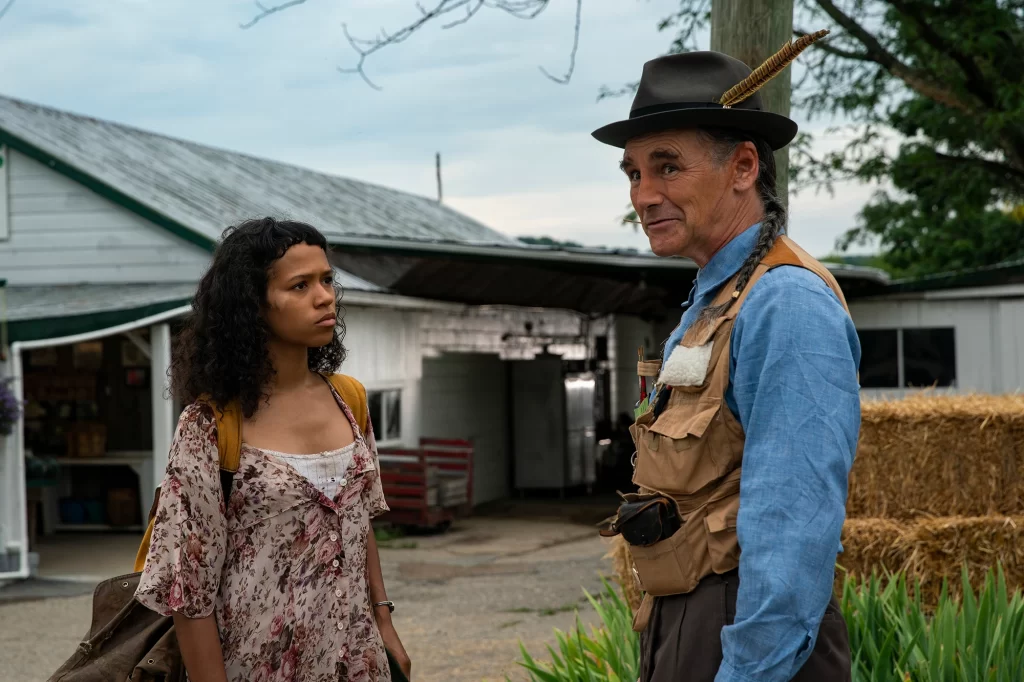
Maren finds Lee during a cross-country road trip as she searches for her estranged mother. The two are naturally drawn to one another during a chance encounter in a small grocery store.
Lee’s brotherly way of defending Maren against an aggressive drunk belies his hardass, uncaring exterior.
Before finding Lee, Maren encounters another ‘Eater’ — an eccentric old man named Sully (played by Mark Rylance) whose attraction to Maren may hold sinister motives.
Rylance is terrifying as Sully. His way of describing his murderous acts in the third person and of ‘’sniffing out’’ Maren is genuinely skin-crawling. Sully invades the teenager’s space with the same creeping intent of a predator who is testing his chosen victim’s boundaries.
Sully offers to show young Maren how to be a functional ‘Eater’ in society and invites her to witness his own methods of hunting which are both revolting and tremendously sad.
Alongside Maren, we are equally reluctant to trust Sully despite his claims to have her best interest at heart. The way in which his inappropriate behavior gradually manifests itself is truly frightening yet predictable to anyone who has encountered his predatory ilk in life.
Maren is torn between the urge to keep herself isolated and thus safe and the desire to fit in with people who understand what she is going through.
This push-pull dynamic permeates her attitude as she runs from perceived dangerous situations in search of belonging. She finds a kindred spirit in Lee, and the two decide to search for her estranged mother together as they navigate America and their own primal desires.
Bones and All is inspired by road movies with forbidden love at their cores, such as Badlands, Sid & Nancy, and True Romance.
However, there is a palpable undercurrent of hopelessness woven throughout Bones which will resonate with many misfits.
Guadagnino is a master of portraying dramatic stories which are peppered with shocking and often grotesque acts.
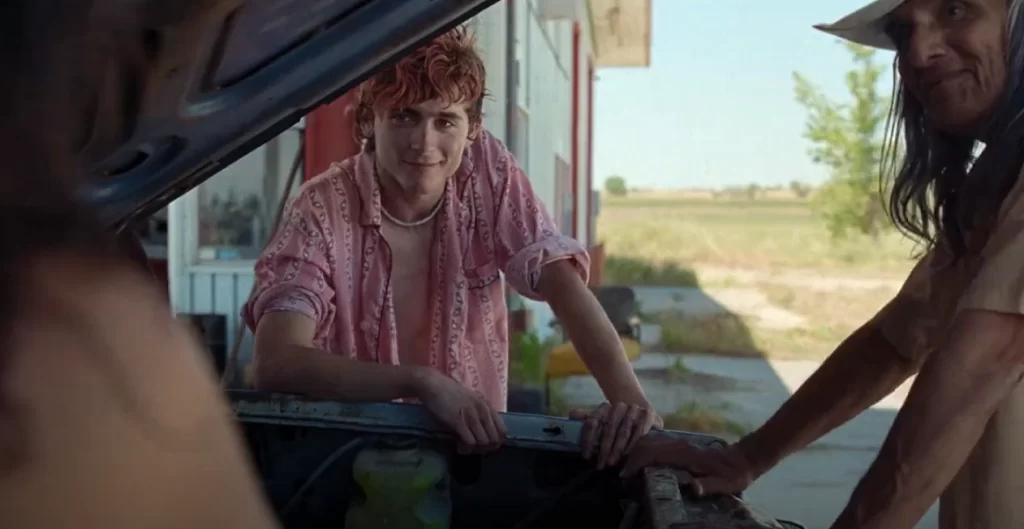
We may forget that we are witnessing a love story once the violence and viscera seep in. Similarly, we may forget that this is a Horror movie as we are so invested in the love which is blossoming between Maren and Lee.
Taylor Russell stuns as Maren. Her youthful naivety is perpetually in conflict with her apparent sixth sense to danger as she mistrusts every person she meets, including other Eaters.
Russell plays an Old Soul imprisoned by the immaturity of youth wonderfully and adds an emotional depth to Maren, rarely seen in mainstream portrayals of teenagers.
Chalamet embodies the carefree, feral nature of Lee perfectly. His cool guy persona can give way to his frenzied bloodlust at break-neck speed resulting in an excitingly unpredictable performance.
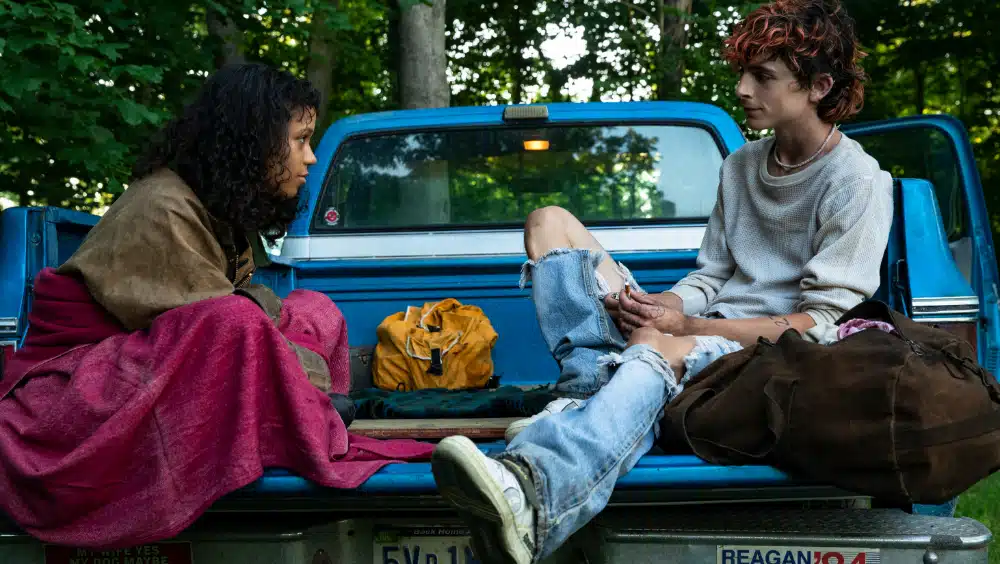
The 90’s aesthetics of the film extend to Maren and Lee’s wardrobes. Maren’s inner fragility is reflected in her dainty floral dress, whilst her chunky combat boots and her father’s oversized leather jacket warn of a tough exterior.
Lee’s dyed flame-colored hair, 90’s cartoon t-shirts, and fringed shirts hang upon his malnourished frame, heightening his Punk demeanor.
Bones and All utilizes photographs as a clever plot device.
Instead of depicting all the deaths in frenzied, bloodied violence, the camera often pans away to focus on photographs of the victims. Who they were and who they were loved by is captured in perfect Kodak moments lending an intimacy and care rarely granted to victims in Horror cinema.
The characters also carry around old Polaroids of the loves they have lost and the lives they have taken to survive.
It should be noted, however, that the film is extremely graphic in places, but most of the murder scenes are sexually charged and fleeting. It is the aftermath that the camera lingers over, exposing the harsh reality of what murder looks like in cold daylight.
There is an alluring nature to the animalistic acts we witness as the characters feed, soaked in blood, as they sit in their underwear with faces buried deep in open wounds. It is intimate and sensual in nature, which I feel has a strong Jorg Buttgereit flavor.
This may not be a film for anyone who feels triggered by bodily fluids. The choice to showcase various forms of spit, snot, and drool somehow feels graphic, even amidst all the blood and gore.
There is something very grounding about a film where the actors openly allow snot and drool to spill from their faces, and Guadagnino’s choice to somehow make this feel graphic in nature only adds to the hyper-real, dirty atmosphere.
Adding to the gritty feel is an array of intimidating, oddball characters with ulterior motives, namely other ‘Eaters’ encountered by Maren and Lee.
Maren’s distrust extends to other cannibals, and a memorable performance from Michael Stuhlbarg cements the paranoia shared amongst Eaters.
Stuhlbarg’s character is genuinely unnerving, and the way in which he describes the act of ‘’going all the way’’ with cannibalism where you eat an entire person ‘’bones and all’’ is extremely unsettling.
Something about how Stuhlbarg delivers his line to Maren made the hair on my neck stand up. It invokes the cat-and-mouse dynamic exhibited by male predators who relish in toying with their female prey.
The undertones of generational trauma and of child neglect lend a self-awareness to Bones and All, which never crosses the line into exploitation cinema.
Instead, the film focuses on the human connections experienced by the outcasted and the broken.
I did not expect to experience such a spectrum of emotions while watching this film. It truly is a journey. We are alongside Maren and Lee as we yearn for them to find peace and belonging in this cruel world.
With a running time of two hours and ten minutes, some audiences may feel that the plot meanders for longer than is needed. But rest assured, your patience is rewarded with a richness of depth in world-building.
At times heart-wrenching, Bones and All reminds us to hold onto the hope that love will eventually find us despite all our flaws.
Overall Rating (Out of 5 Butterflies): 5







Follow Us!