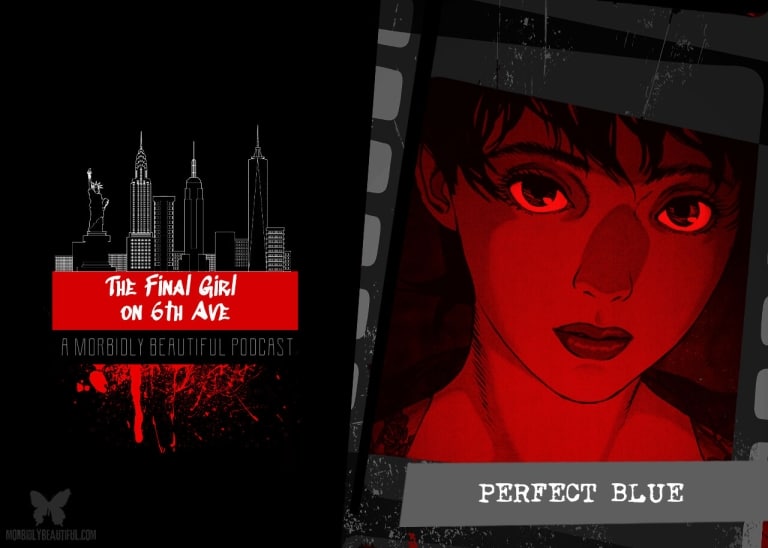
Final Girl on 6th Ave: Perfect Blue (1997)



Show host Carolyn Smith-Hillmer takes a deep dive into Perfect Blue, a masterwork whose influence on animation and cinema at large cannot be overstated. The film’s exploration of identity, the dangers of celebrity, and the blurred lines between reality and illusion have only grown more pertinent in the decades since its release. – Stephanie (Editor-in-Chief)
SHOW NOTES FROM HOST CAROLYN SMITH-HILLMER:
Editor’s Notes:PERFECT BLUE is a groundbreaking psychological thriller that blurs the lines between reality and illusion in a way that I previously thought only David Lynch could do. Tune in, turn on, and drop out, as I guide you through the themes of identity, mental illness, and how those around us can impact both.
Perfect Blue has had a significant influence on both Japanese and Western filmmakers. Its exploration of identity, fame, and psyche has resonated with audiences and creators alike, with its impact visible in films like Darren Aronofsky’s Requiem for a Dream (2000) and Black Swan (2010). Aronofsky even acquired the rights to the film to recreate specific scenes, most notably the bathtub sequence in Requiem for a Dream, a direct homage to Mima’s iconic breakdown in the film.
The movie’s themes of celebrity culture and the dangers of losing oneself in a constructed identity have only become more relevant with the rise of social media, where influencers and celebrities constantly curate their public personas.
The film’s prescient depiction of digital identity and the blurred lines between the online and real self have contributed to its lasting relevance and status as a cult classic.

Satoshi Kon’s later works, such as Millennium Actress (2001), Tokyo Godfathers (2003), and Paprika (2006), continued to push these boundaries, solidifying his reputation as a master of psychological storytelling.
The strength of Perfect Blue lies in its ability to weave a compelling narrative that challenges the viewer’s perception of reality while offering a biting critique of the entertainment industry. Satoshi Kon’s direction is masterful; he uses animation not as a limitation but as a tool to explore themes that might have been less effective in live-action.
The film’s visual storytelling, characterized by stark contrasts between Mima’s public persona and her inner turmoil, immerses the audience in her psychological descent.
The film’s pacing and atmosphere are also key components of its strength. The tension is meticulously built, with a slow-burn approach that escalates into a fever pitch as Mima’s sense of self crumbles. The haunting score by Masahiro Ikumi enhances this atmosphere, adding a layer of unease and disorientation that mirrors Mima’s mental state.
This episode contains spoilers, so if you haven’t seen this essential cinematic classic, watch before listening unless you want to be spoiled.

The Final Girl on 6th Ave is a weekly show where host, Carolyn Smith-Hillmer, dissects an arthouse/elevated horror film. Each episode includes a detailed play-by-play of the film itself and a subsequent deep dive into the thematic elements and symbolism. Because elevated horror is sometimes viewed within the horror community as pretentious, Carolyn makes sure to use her down-to-earth tone and unique perspective to make these films less intimidating for the casual horror viewer and less ostentatious for the genre lover.
Listen to more episodes on the show’s website here.
The Final Girl on 6th Ave is a bi-weekly podcast where host Carolyn Smith-Hillmer reviews arthouse horror films in a non-pretentious way.
Lars von Trier has been called a visionary, a sadist, and a self‑mythologizing provocateur—sometimes all in the same breath. In this episode, we unpack how an anxious kid from Copenhagen became one of the most controversial figures in world cinema, and why his work looms so large over modern horror and “extreme” art‑film. Focusing on Antichrist, Melancholia, Nymphomaniac, and The House That Jack Built, we explore von Trier’s “Depression Trilogy,” his use of grief, sex, and violence, and the ongoing debates about misogyny, ethics, and audience complicity. Along the way, we bring in film scholarship, critical essays, and production histories to ask a simple but uncomfortable question: when von Trier pushes horror this far, is he revealing something profound about suffering—or just building a house out of pain?
SOURCES/INFORMATION
Biographical and career overviews
“Lars von Trier.” Wikipedia.wikipedia
“Lars von Trier – Simple English Wikipedia.” Simple Wikipedia.wikipedia
“Lars von Trier.” Encyclopaedia Britannica (biography, awards, filmography).britannica
“Lars von Trier filmography.” Wikipedia.wikipedia
“Lars von Trier – IMDb.” IMDb.imdb
“List of awards and nominations received by Lars von Trier.” Wikipedia.wikipedia
Context and Danish film culture
“Lars von Trier and Cultural Liberalism.” Danish Film Institute.dfi
Excerpt from Regional and Global Dimensions of Danish Film Culture and Film Policy (on Dogme 95 and Danish film branding).catalogimages.wiley
Critical profiles and interviews
“Lars von Trier: Behind the Curtain.” The New Yorker (profile on von Trier’s persona and controversies).mubi+1
“Lars von Trier: A Problematic Sort of Ladies’ Man?” NPR radio piece and transcript (Pat Dowell, with Caroline Bainbridge).npr+1
“The Many Faces of Lars von Trier.” BFI feature.bfi
“Lars von Trier: An Overview.” Film Festival Today (career overview).filmfestivaltoday
Horror‑specific and film‑specific sources
“The Immersive Examination of Depression and Grief in ‘Antichrist’ [Unveiling the Mind].” Bloody Disgusting.bloody-disgusting+1
“Antichrist (2009)” – film entry and production details. IMDb and Wikipedia.imdb+1
“The House That Jack Built (2018).” IMDb (plot, reception).imdb
“Manically Macabre: Lars von Trier as Horror Icon.” Horror Obsessive.horrorobsessive
“‘Terrifier 2’ and 9 Other Horror Movies Which Famously Made Audiences Sick.” Collider (section on Antichrist).collider
Scholarly / analytical work
“Lars von Trier – The ‘Sex’pression Ideology.” Academic essay (via Academia.edu PDF).academia
Caroline Bainbridge, The Cinema of Lars von Trier (discussed in NPR and academic contexts).npr+1
Career primers
“Notebook Primer: Lars von Trier.” MUBI Notebook.



She’s a lover, he’s a fighter. Together, they’re CHEER AND LOATHING. Tune in to hear your hosts, Stephanie (Cheer) and Casey (Loathing), clash over the films they love — and the ones they love to hate.
In this holiday extravaganza episode of Guilty Pleasures, join hosts Stephanie, Kelly, and our newest addition, Jonathan (Jack was tied up in tinsel and couldn't join us), as they unwrap the bizarre and unhinged world of holiday cinema. They dive into the depths of Elves, a film that's as chaotic as it is entertaining. It's a sleigh full of questionable decisions, diabolical dialogue, absurd plot twists, wildly offensive antics, and unhinged holiday mischief.
And that's not all! In the second half of the podcast, join your festive cinephile friends for a look at four more ”nutty as a fruitcake” holiday treats: A New York Christmas Wedding, Elf Bowling, A Medea Christmas, and Jack Frost. Plus, we each offer a bonus Christmas flick guaranteed to make you say, ”Ho, Ho, HO-LY Hell!”
Expect laughter, disbelief, and a spirited debate about what truly makes a movie a guilty pleasure. Don't miss this festive journey through the weirdest corners of holiday films!








Follow Us!