Final Girl on 6th Ave: Rosemary’s Baby (1968)


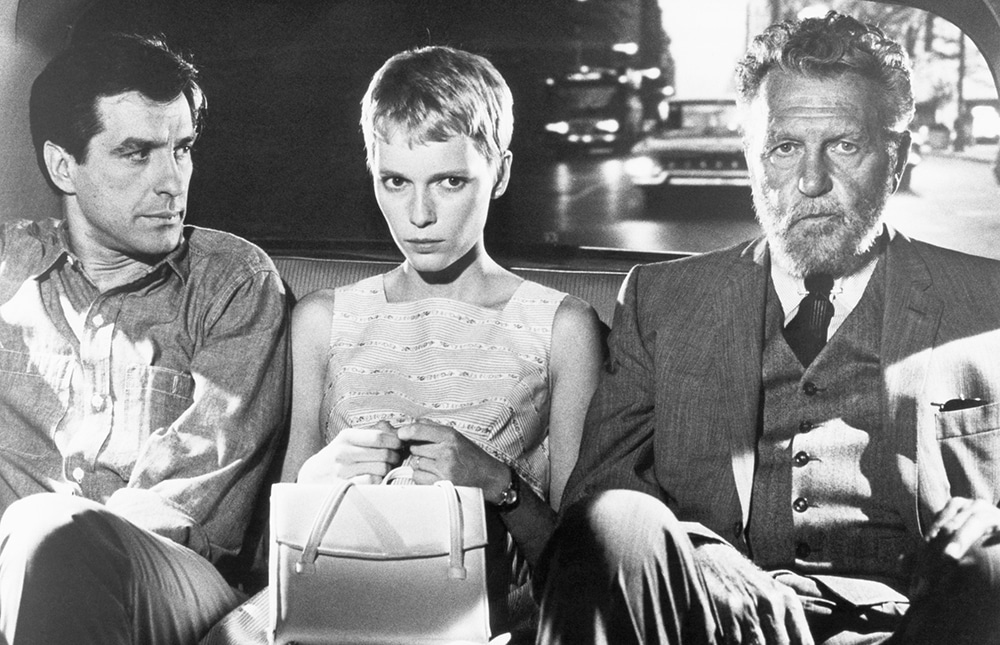
Show host Carolyn Smith-Hillmer takes a deep dive into the 1968 classic psychological horror film Rosemary’s Baby, directed by controversial filmmaker Roman Polanski and based on Ira Levin’s 1967 novel of the same name. It’s considered a landmark within the horror genre for its focus on the occult and naturalistic approach that emphasizes psychological tension. More than 50 years later, it continues to influence genre filmmakers, including Ari Aster, Jordan Peele, and Darren Aronofsky, among many others. Despite Polanski’s problematic legacy, his magnum opus, Rosemary’s Baby, remains one of the most important milestones in the genre. – Stephanie (Editor-in-Chief)
SHOW NOTES FROM HOST CAROLYN SMITH-HILLMER:
Editor’s Notes:I’m very excited today to be talking to you about a film that honestly scares the f*ck out of me. I can’t sit here and act like it doesn’t. Even though some may view it as dated, it remains (to this day) a story that will never not be frightening.
Rosemary’s Baby (1968) stars Mia Farrow as a newlywed living in Manhattan who becomes pregnant but soon begins to suspect that her neighbors are members of a Satanic cult who are grooming her in order to use her baby for their rituals.
The film was born out of the fall of the Motion Picture Production Code and the era of strict censorship, as well as a complicated socio-political landscape that pushed women’s issues of healthcare and bodily autonomy to the forefront of popular discourse (sadly, there’s a good reason the film continues to resonate and feel resonant more than five decades later).
In 1960, the first oral contraceptive in the US was approved by the FDA. 1965’s Griswold v. Connecticut ended state laws that could restrict access to the pill. In 1975, Roe v. Wade legalized abortion nationwide. As women’s reproductive rights progressed, the powerful conservative Christian constituency railed against the moral decline of America. This hotbed of divisive politics fueled the metaphor-heavy horror of Rosemary’s Baby.

Like all of our most influential horror films, Rosemary’s Baby drew inspiration from real-world fears and anxieties.
The film struck a chord with a nation reeling from JFK’s assassination and the Vietnam War, as well as the coming sea change brought about by the civil rights movement and the birth of the counterculture generation.
It was a critical and box office success, grossing over $30 million in the United States, and received acclaim from critics. The film was nominated for several accolades, including multiple Golden Globe Award nominations and two Academy Award nominations, winning Best Supporting Actress (for Ruth Gordon) and the Golden Globe in the same category.
Since its release, Rosemary’s Baby has been widely regarded as one of the greatest horror films of all time. It’s a masterclass in paranoia and seething terror.
Spoilers abound in this episode, so if you’ve managed to miss this genre classic, make sure you watch before listening unless you want to be spoiled.

The Final Girl on 6th Ave is a weekly show where host, Carolyn Smith-Hillmer, dissects an arthouse/elevated horror film. Each episode includes a detailed play-by-play of the film itself and a subsequent deep dive into the thematic elements and symbolism. Because elevated horror is sometimes viewed within the horror community as pretentious, Carolyn makes sure to use her down-to-earth tone and unique perspective to make these films less intimidating for the casual horror viewer and less ostentatious for the genre lover.
Listen to more episodes on the show’s website here.
The Final Girl on 6th Ave is a bi-weekly podcast where host Carolyn Smith-Hillmer reviews arthouse horror films in a non-pretentious way.
Lars von Trier has been called a visionary, a sadist, and a self‑mythologizing provocateur—sometimes all in the same breath. In this episode, we unpack how an anxious kid from Copenhagen became one of the most controversial figures in world cinema, and why his work looms so large over modern horror and “extreme” art‑film. Focusing on Antichrist, Melancholia, Nymphomaniac, and The House That Jack Built, we explore von Trier’s “Depression Trilogy,” his use of grief, sex, and violence, and the ongoing debates about misogyny, ethics, and audience complicity. Along the way, we bring in film scholarship, critical essays, and production histories to ask a simple but uncomfortable question: when von Trier pushes horror this far, is he revealing something profound about suffering—or just building a house out of pain?
SOURCES/INFORMATION
Biographical and career overviews
“Lars von Trier.” Wikipedia.wikipedia
“Lars von Trier – Simple English Wikipedia.” Simple Wikipedia.wikipedia
“Lars von Trier.” Encyclopaedia Britannica (biography, awards, filmography).britannica
“Lars von Trier filmography.” Wikipedia.wikipedia
“Lars von Trier – IMDb.” IMDb.imdb
“List of awards and nominations received by Lars von Trier.” Wikipedia.wikipedia
Context and Danish film culture
“Lars von Trier and Cultural Liberalism.” Danish Film Institute.dfi
Excerpt from Regional and Global Dimensions of Danish Film Culture and Film Policy (on Dogme 95 and Danish film branding).catalogimages.wiley
Critical profiles and interviews
“Lars von Trier: Behind the Curtain.” The New Yorker (profile on von Trier’s persona and controversies).mubi+1
“Lars von Trier: A Problematic Sort of Ladies’ Man?” NPR radio piece and transcript (Pat Dowell, with Caroline Bainbridge).npr+1
“The Many Faces of Lars von Trier.” BFI feature.bfi
“Lars von Trier: An Overview.” Film Festival Today (career overview).filmfestivaltoday
Horror‑specific and film‑specific sources
“The Immersive Examination of Depression and Grief in ‘Antichrist’ [Unveiling the Mind].” Bloody Disgusting.bloody-disgusting+1
“Antichrist (2009)” – film entry and production details. IMDb and Wikipedia.imdb+1
“The House That Jack Built (2018).” IMDb (plot, reception).imdb
“Manically Macabre: Lars von Trier as Horror Icon.” Horror Obsessive.horrorobsessive
“‘Terrifier 2’ and 9 Other Horror Movies Which Famously Made Audiences Sick.” Collider (section on Antichrist).collider
Scholarly / analytical work
“Lars von Trier – The ‘Sex’pression Ideology.” Academic essay (via Academia.edu PDF).academia
Caroline Bainbridge, The Cinema of Lars von Trier (discussed in NPR and academic contexts).npr+1
Career primers
“Notebook Primer: Lars von Trier.” MUBI Notebook.


She’s a lover, he’s a fighter. Together, they’re CHEER AND LOATHING. Tune in to hear your hosts, Stephanie (Cheer) and Casey (Loathing), clash over the films they love — and the ones they love to hate.
In this holiday extravaganza episode of Guilty Pleasures, join hosts Stephanie, Kelly, and our newest addition, Jonathan (Jack was tied up in tinsel and couldn't join us), as they unwrap the bizarre and unhinged world of holiday cinema. They dive into the depths of Elves, a film that's as chaotic as it is entertaining. It's a sleigh full of questionable decisions, diabolical dialogue, absurd plot twists, wildly offensive antics, and unhinged holiday mischief.
And that's not all! In the second half of the podcast, join your festive cinephile friends for a look at four more ”nutty as a fruitcake” holiday treats: A New York Christmas Wedding, Elf Bowling, A Medea Christmas, and Jack Frost. Plus, we each offer a bonus Christmas flick guaranteed to make you say, ”Ho, Ho, HO-LY Hell!”
Expect laughter, disbelief, and a spirited debate about what truly makes a movie a guilty pleasure. Don't miss this festive journey through the weirdest corners of holiday films!








Follow Us!