


While it’s a thrill for horror fans to see “Longlegs” dominating the box office, it doesn’t live up to its extraordinary marketing campaign.
No time to read? Click the button below to listen to this post.
There has been a lot of buzz around Osgood Perkin’s Longlegs, with Neon putting more time into publicity than might be expected for a small-to-mid-budget horror effort. Perhaps the monumental rise of A24 – a studio with a good roster of horror that has spectacularly succeeded by buying into new ideas and promoting them well – has played a role in that. While it still pales in comparison to the frankly absurd amount of promotion around the new Deadpool & Wolverine movie (if Ryan Reynolds has taught us anything, it’s that shameless self-promotion is cool so long as you make a joke out of it), it’s nice to see a movie like Longlegs, that is not afraid to lean into its weirdness, being shown such a confident backing from the studio.
The 14A rating (Canadian; the film has an R-rating in America) also suggests Neon is keen to reach as wide an audience as possible. This does mean that much of the violence is limited to splashes of red from off-screen, but don’t let that scare you off. One harrowing scene reminiscent of Talk to Me stands out exactly because of the reserve shown elsewhere.
Longlegs’ premise of an FBI agent trying to hunt down a serial killer and his occult connections may not be the most original, but there is certainly potential within that for a new and solid interpretation.
The thing that most pushes it towards realizing that potential is its setting and cinematography. Longlegs was filmed in Vancouver, a regular stand-in for a host of forested, rural, and suburban US locations, but a special effort seems to have been made to find the drabbest and dreariest areas of the Canadian West Coast, exhibiting a number of atmospheric negative spaces. While highly unlikely to appear in any travel brochure, these seemingly empty environments add to a sense of creeping, dreamlike dread that pervades the film.
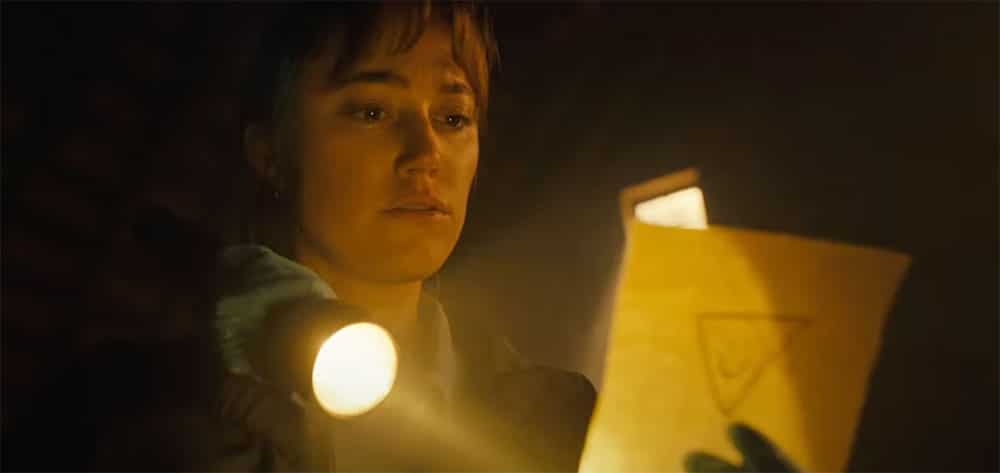
One memorable scene in an abandoned barn is particularly well-shot, alongside beautiful lighting.
Elsewhere, the film alternates between interiors that are overcrowded and narrow or wide and barren, with both proving effective as echoes of the complicated psychology of the serial killer and the emotional unavailability of Longlegs’ protagonist.
Maika Monroe is that protagonist, FBI agent Lee Harker, a character more in the mold of Fringe’s Olivia Dunham than Dana Skully, complete with wide-collared shirts and repressed childhood trauma.
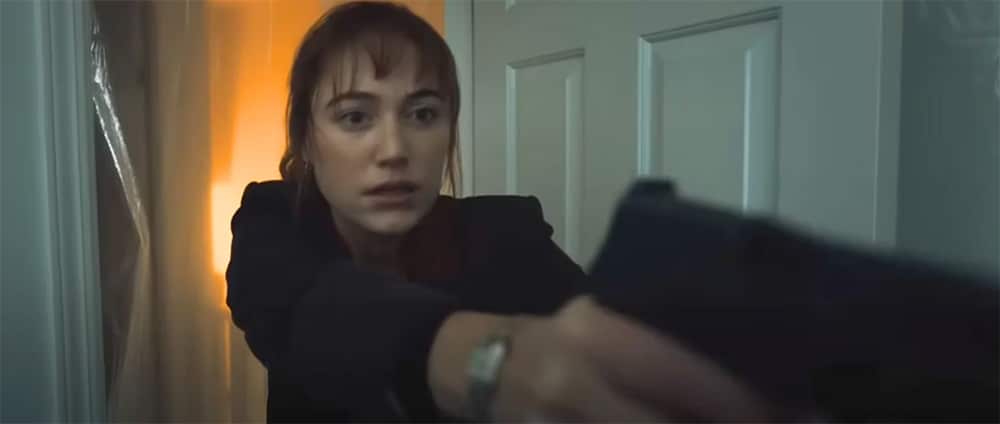
Like Dunham, she has a habit of losing partners and a tendency at those times to run headlong after the threat rather than call in for backup.
Harker is also a little bit psychic, or what her superior officer calls ‘half-psychic’, or maybe she’s just ‘highly intuitive’ – no one is really sure and it rarely seems to matter. Cold but effective, like her namesake Jonathan Harker, Lee is in pursuit of a pasty individual who has an uncanny knack for controlling minds and coercing his victims into murder on his behalf.
This is the serial killer who calls himself Longlegs, played by a prosthetically altered Nicholas Cage.
In a short interview that ran before the film, Perkins describes Cage as a Christmas present that turns out to be exactly what you expected, and Nic Cage is here very much Nic Cage, head-tilting smile and all.
Of course, Cage is an actor of many faces (or at least three), and this is a performance that sheds the subtlety of recent efforts like Pig or Dream Scenario in favor of something more in line with Prisoners of the Ghostland or, to travel a little farther back, Big Daddy in Kick-ass (specifically when he is on fire).
This is a k-k-kerazy villain that bursts into song mid-conversation and answers straightforward questions with cryptic but violently suggestive answers.

After the release of the first images of the character, a number of sites described Cage as ‘terrifying’, but that depends on how terrifying you would find Mrs. Doubtfire dressed as a country-singing mime. On second thought, that does sound pretty terrifying, but the result in Longlegs is a character that, while sometimes able to get under your skin, just as often makes you want to chuckle.
Ultimately, this is one of the problems of the film as a whole: it plays hopscotch along the line that divides unsettling from silly, falling frequently but unsatisfyingly on either side.
There was potential within a slightly familiar premise to offer something new, but the occult angle here rarely breaks out of that familiarity, filled as it is with quoted biblical passages, rock ‘n roll references and literal cries of ‘Hail Satan’. Watching this and other films such as the recent Late Night with the Devil, it’s hard not to wish that movies dealing with the occult would break free from the rote Satanic Panic and Manson themes to tackle religious fanaticism with more originality (and besides, the devil would surely prefer dubstep to Rock n’ Roll).
2015’s The Invitation, for example, is far more unnerving for its refusal to get too caught up in the by-now well-known sensational elements of US cults.
Finally, while the setting and cinematography of Longlegs are sometimes brilliant, its familiarity and dollops of silliness may undermine the terror for those going into the theatre expecting a genuine scare.
Overall Rating (Out of 5 Butterflies): 3









Follow Us!