

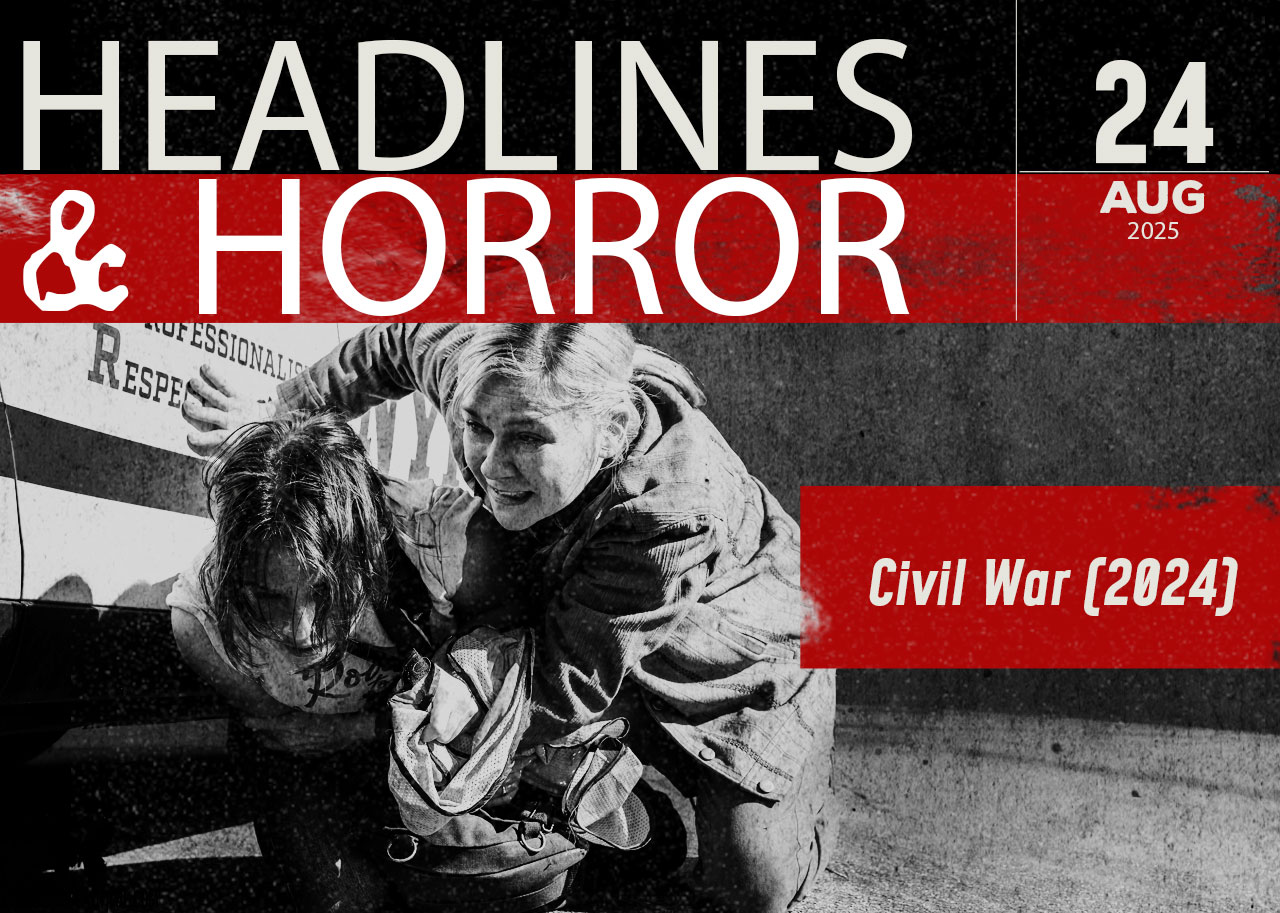
“Civil War” is a warning, and today’s headlines feel like a prelude. Watch it to be horrified, or to protect what still remains.

No time to read? Click the button below to listen to this post.

The news cycle is dizzying these days, but every so often, a headline lands with the weight of history.
One such headline: the National Guard has now been mobilized in 19 states. Depending on your perspective, that sentence might conjure relief or dread. For some, the Guard represents safety and stability in times of unrest. For others, it is a reminder of a militarized government willing to turn its power inward.
Either way, the deployment of soldiers on American soil is not a neutral act. It’s a decision heavy with political meaning, one that reshapes our national identity and signals how fragile the line between democracy and authoritarianism really is.

History tells us this is not new.
In 1970, four students were killed at Kent State when the Guard opened fire on unarmed protestors. During the Civil Rights movement, state and federal forces were used both to uphold and to resist segregation, depending on who controlled them. In 2020, Guard troops flooded American cities during Black Lives Matter protests, a show of force that blurred the distinction between crowd control and intimidation.
Each instance left scars—not just physical, but cultural. They forced us to reckon with a question we still don’t like asking: when the state mobilizes the military against its own citizens, who exactly is being protected, and from whom?
That question lies at the heart of Alex Garland’s 2024 film Civil War.
THE RIGHT FILM FOR THE RIGHT TIME

Though not a horror film in the traditional sense, Garland’s vision is one of the most terrifying cinematic experiences in recent memory precisely because it feels so real.
There are no monsters, no ghosts, no fantastical allegories. What Garland gives us is a fractured America collapsing into armed conflict; it’s a vision that is speculative in name only. Watching it now, against the backdrop of a nation mobilizing its soldiers in nearly half the country, feels less like fiction and more like prophecy.
Civil War follows a group of journalists. They are truth-seekers trying to cross the dangerous landscape of a disintegrating America. Their mission is both urgent and futile: to document what’s happening before the collapse is complete, to leave behind a record of how democracy dies.
Garland, known for the unsettling precision of films like Ex Machina and Men, directs with an unflinching eye. He gives us no easy villains and no comforting answers.
The violence feels inevitable, the politics terrifyingly vague.
That vagueness is the point: Garland wants us to see not the specifics of how America falls apart, but the inevitability that it could.

The film is rich with themes that resonate in our current moment.
It’s about the fragility of truth in an era of disinformation. When propaganda replaces news, chaos becomes easier to spread than facts. It’s about the corrosion of trust between citizens and institutions.
It’s about journalists—increasingly vilified, increasingly endangered—as the last line of defense against collective amnesia. They become target, messenger, and memory-keeper… often all at once.
It’s about eroding institutions. They fail slowly, then all at once. Once trust breaks, only force fills the void. It’s about the militarization of politics.
And it’s about the militarization of politics and the slow normalization of violence, where images of soldiers in the streets become background noise. Soldiers walking streets become a mood, not a state—blurring war and governance.
Watching it, one can’t help but think of today’s headlines, where the mobilization of military forces within the United States is presented as routine, even necessary.
WHY IT MATTERS

What makes Civil War so effective, and so chilling, is its refusal to exaggerate.
There’s no dystopian filter here, no futuristic tech, no heightened spectacle. The vision of America on screen looks exactly like the one we live in now. That’s what makes it horror-adjacent: it weaponizes recognition.
The horror is not in the possibility of collapse but in the recognition that the seeds are already sown. When Garland shows us armed factions, distrust in the media, and the casual presence of military power in daily life, it doesn’t feel speculative. It feels like tomorrow’s news.
This is why the mobilization of the National Guard across 19 states should give us pause. It’s not inherently sinister, but history shows us how easily “protection” can slip into “control.” Garland’s film reminds us that democracies don’t usually fall all at once.
They erode piece by piece, headline by headline, until the unimaginable becomes routine.
WATCH CIVIL WAR NOW

For horror fans and everyone who believes they still live in a stable, responsive democracy, Civil War is essential (perhaps required) viewing. It may not feature slashers or supernatural specters, but it captures something far scarier: the collapse of the familiar world we take for granted. It isn’t about blood or monsters; it’s about a country bleeding trust and mourning memory.
If you shrug off 19 states under guard as “just procedure,” Civil War will remind you: procedure is how regimes normalize. If you can watch this movie without being unsettled, you might be too comfortable with what’s coming.
Horror has always been political. From Romero’s zombies to Peele’s suburban nightmares, the genre thrives on reflecting the anxieties of its time. Garland has given us a new entry in that tradition—one that strips away allegory and dares us to confront the real-world terror of a democracy on the brink.
Garland doesn’t offer comfort; he offers reflection, and the painful recognition that the collapse of democracy often happens not with a bang but a series of quiet, unremarkable decisions.
The scariest part of Civil War isn’t the violence onscreen. It’s that we can read today’s headlines and see how close we already are.
Overall Rating (Out of 5 Butterflies): 4.5







Follow Us!