

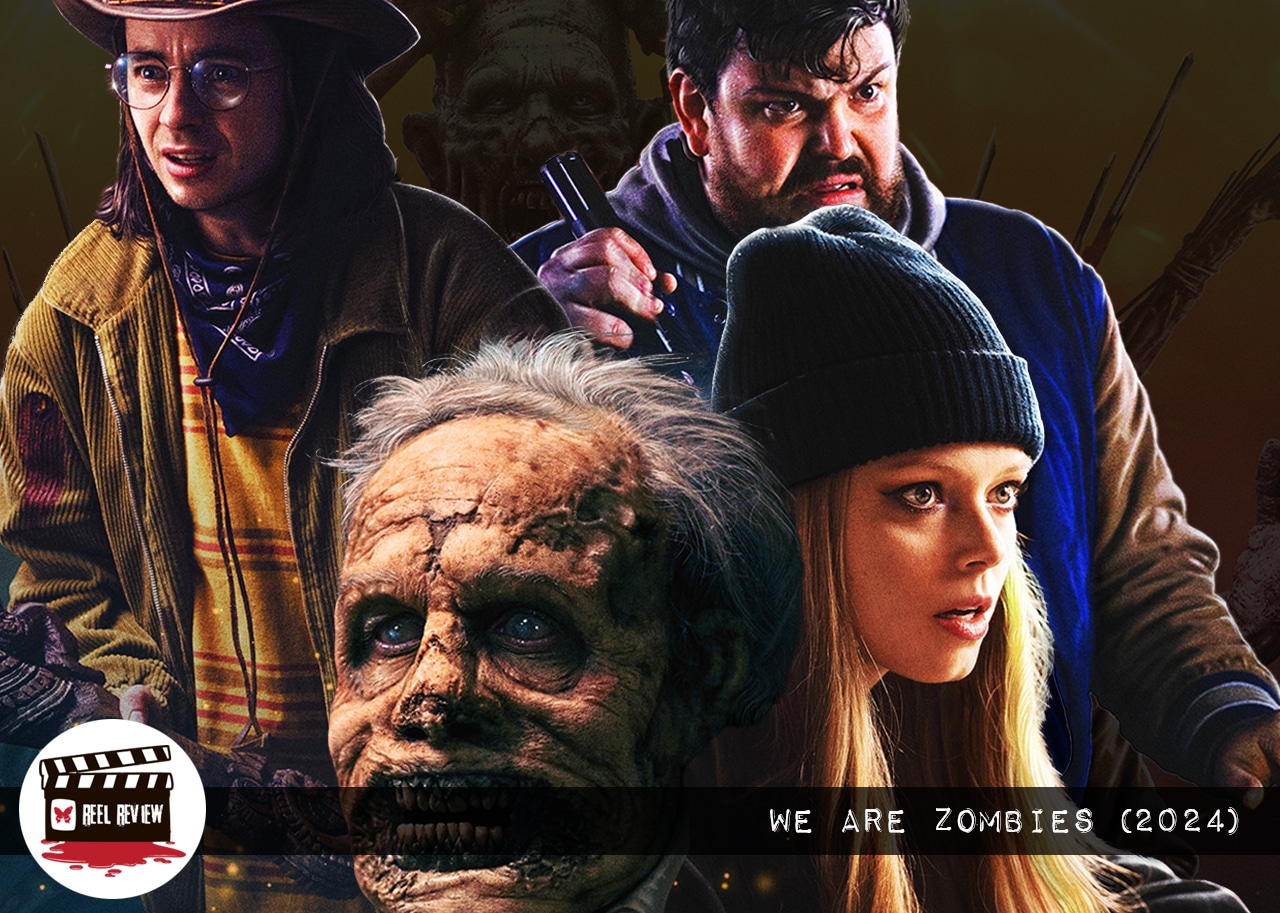
The wildly fun “We Are Zombies” has something important to say, but you might be too busy enjoying the gore and hilarity to notice or care.
No time to read? Click the button below to listen to this post.
RKSS’ (Roadkill Superstars) offers another spunky entry to fortify their likeably quirky, 80s-loving style and brand.
Bottom line (or lactose-free skinny)? If you rolled out Deadpool & Wolverine through a Taika Waititi pasta maker and then cut it with an early-career Kevin Smith knife and sprinkled it with an aggressive helping of glitter, you’ve got We Are Zombies.
RKSS’ collaborative brand (Turbo Kid, Summer of 84) is locked with this third feature, Folks. It’s a lovely little blend of slacker camaraderie, crudeness, and some biting social commentary concealed by comedy.
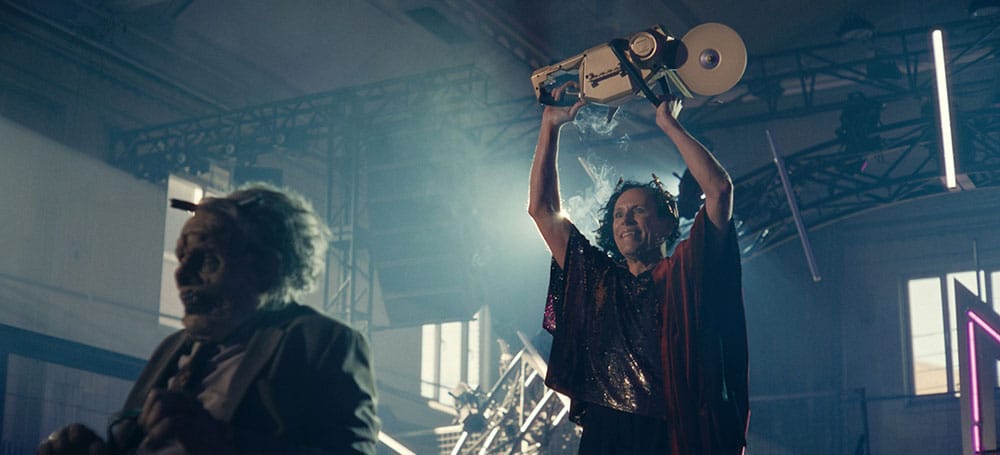
And don’t you worry your pretty little securely attached head; there’s plenty of gore to go around and around and around, especially in the final act (hip-hip-hooray for some solid circular saw action).
Important context for this take: I saw We Are Zombies and Deadpool & Wolverine within a 24-hour window. This unexpectedly perfect pairing of Canadian-led chaos caused a lovely reflection on the required reverence to successfully pull off gory irreverence.
(I think seeing them in such close succession made me appreciate and like both films more.)
We Are Zombies’ set-up goes hard and fast.
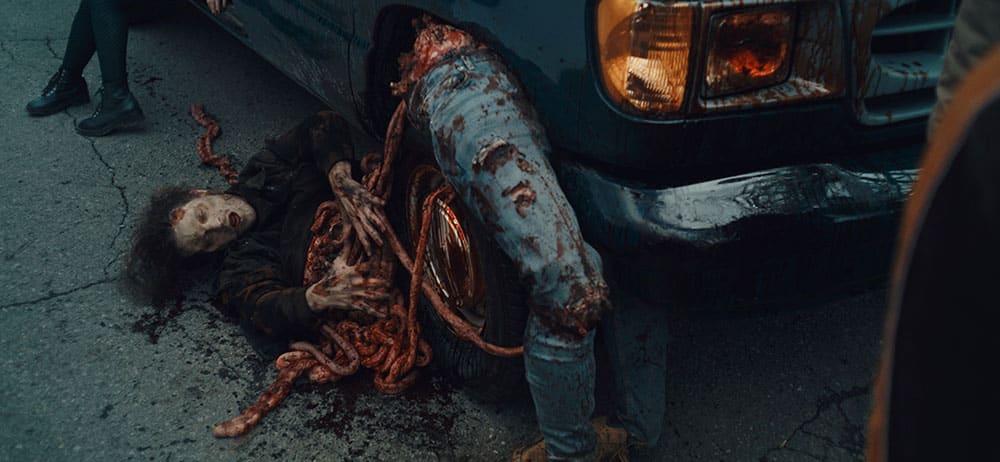
It lets us know from the jump where the non-cannibalistic zombies, also known as the living impaired, stand in this world’s social hierarchy while simultaneously setting the comedic tone. The capable introductory sequences deserve credit for not pushing the politics or slapstick too hard.
We see the zombies as non-violent neighbors. However, they face stigma, discrimination, and violence from “zombiphobes” and opportunists looking to capitalize off of the inequity—individually (the gold tooth incident at Franky’s) and systemic (all things Coleman, the corporate juggernaut or Vought International of this context, and some police-related content).
Yet, rather than landing heavily, the tight humor and crisp editing had me laughing audibly and settling quickly into the concept.
The entire pick-up scene of the first family’s loved one by Coleman’s ‘retirement service for the living impaired’ had me in absolute stitches. Hence, the nod to Waititi, who wields this kind of balance in works like Jojo Rabbit and Reservation Dogs. Goodness, it takes intelligence, lived experience, and confidence bordering on recklessness to attempt projects like this, and I truly enjoy watching artists with these characteristics attempt them, even if not all passes stick.
I’m sure some of the credit for this goes to the source material, the French comic book series The Zombies That Ate the World, which I am admittedly unfamiliar with.
RKSS’ Anouk Whissell, François Simard, and Yoann-Karl Whissell were capable hands to trust in transitioning this concept from page to screen.
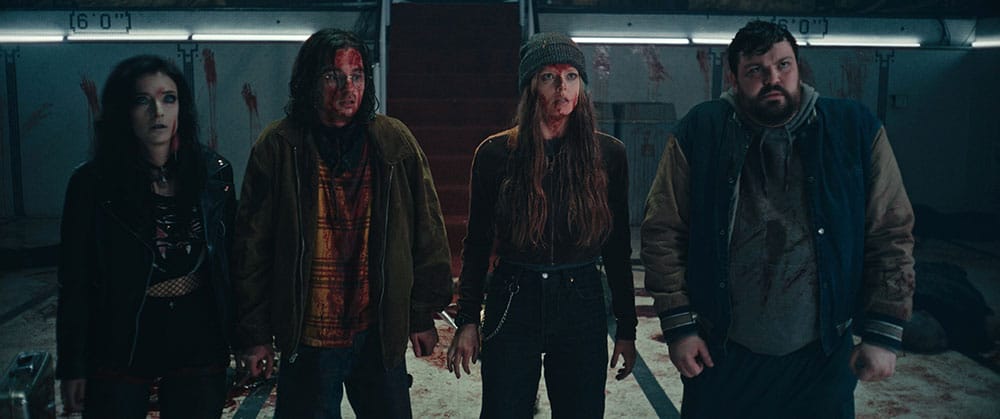
Additionally, the core cast is so likeable (Marc-André Boulanger’s Rocco and Clare Coulter’s Mrs. Neard were even lovable) and the pace so dynamic that even when some of the jokes land flat, forgiveness came naturally and easily—especially when there were so many memorable moments and choices.
Let’s explore some of those choices. But beware, we are now entering spoiler territory.
Back to gory irreverence, we go!
SPOILER ALERT
There are two glorious inclusions I have to acknowledge: Shiva The Destroyer and Mother Teresa–both presented in zombie form. Yes, you read that correctly. I wish these two hadn’t been teased in the trailer or included in the movie poster to encourage more WTF moments for those who go in cold.
There must have been reasons for including these two well-known spiritual leaders in some of the most violent and blood-soaked sequences. This gal hopes one of you podcasters will interview RKSS and ask them about this (please and thank you).
Shiva, The Destroyer.
Traditional mythology talks about the duality and complexity of this deity as both creator and destroyer. (Shiva has also been incorporated into many Dungeons & Dragons campaigns, and like any good ’80s, nerd-centered film/show, D&D pops up periodically.) Visually, Shiva is a force and caused me to gasp with delight when he appeared on screen. I desperately wanted to zoom in and examine the construction and makeup in detail.
Then, when Shiva turned from a harmless sideshow to a multi-limbed murder machine, I was IN.
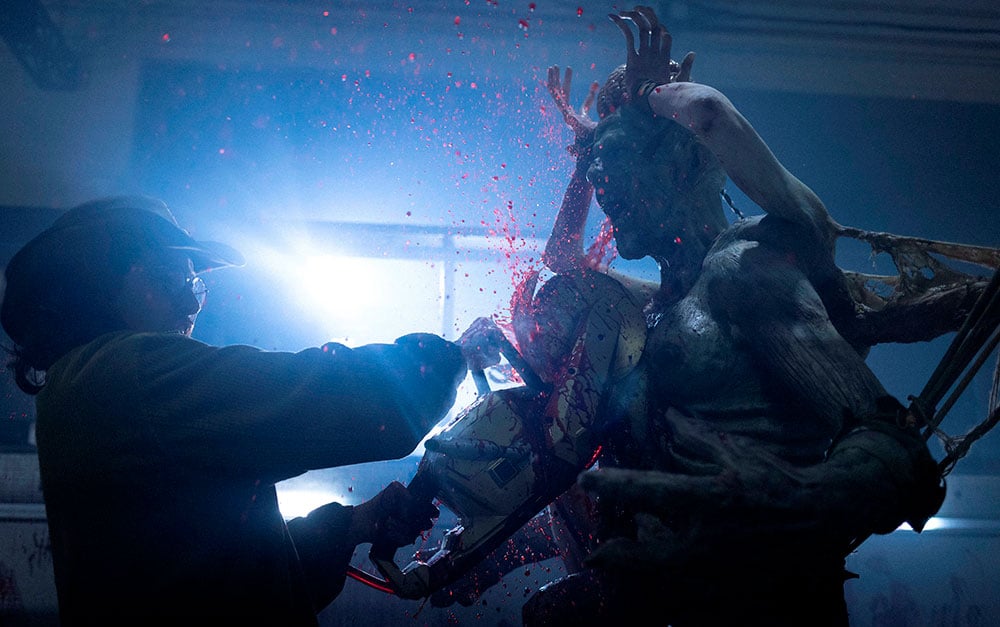
I like thinking about Shiva’s inclusion as a way to ask us to reflect on the multiplicity of human nature (maybe I’m getting too deep here; it may have just been to look cool). Given the other smart choices, though, I want to believe this. I mean, we get to see multiple sides of all of the core human and zombie characters–the good, bad, ugly, kinky, sensitive, etc.
So, who would be another great character with whom to explore polarity? How about… Mother Teresa? Mama T makes an unexpected “cameo” and then, like Shiva, succumbs to the villain’s diabolical plans and contributes generously to the body count during the rampaging climax.
So, why Mother Teresa? I did a little digging.
While offering compassion to so many, she also held this stance on abortion, “….I feel the greatest destroyer of peace today is abortion because it is a direct war, a direct killing – direct murder by the mother herself.” For those of us keen on the accessibility and importance of reproductive rights, this is less emphasized yet important information about this “saint”.
If the undercurrent of We Are Zombies asks us to hold up a societal mirror and unpack some shitty power dynamics and systemic oppression, it helps to put someone historically presented as revered or beloved in front of it to reveal their complexity and spur reflection. (Then promptly execute them because we can’t let feelings get in the way of fun, right? ….right?)
Beneath its ridiculous package and blood-soaked facade, this one’s got a lovable softcore.
People are messy, zombies are messy, capitalism is messy, glitter is messy, and We Are Zombies is messy. All these things are true, and I embraced them.
I found beauty in this particular kind of mess and most definitely recommend placing this one high on your watch list.
Overall Rating (Out of 5 Butterflies): 3.5
This SCREAMBOX Original streams on August 13. You can start screaming now with SCREAMBOX on iOS, Android, Apple TV, Prime Video, Roku, Fire TV, YouTube TV, Samsung, Comcast, Cox, and Screambox.com.











Follow Us!