American Horror: A Cinematic Mirror to Social Decay


Horror cinema has long served as society’s dark mirror, reflecting our deepest anxieties and confronting us with uncomfortable truths about ourselves. In times of social upheaval, these films become particularly resonant, offering prophetic warnings about the consequences of our collective choices.
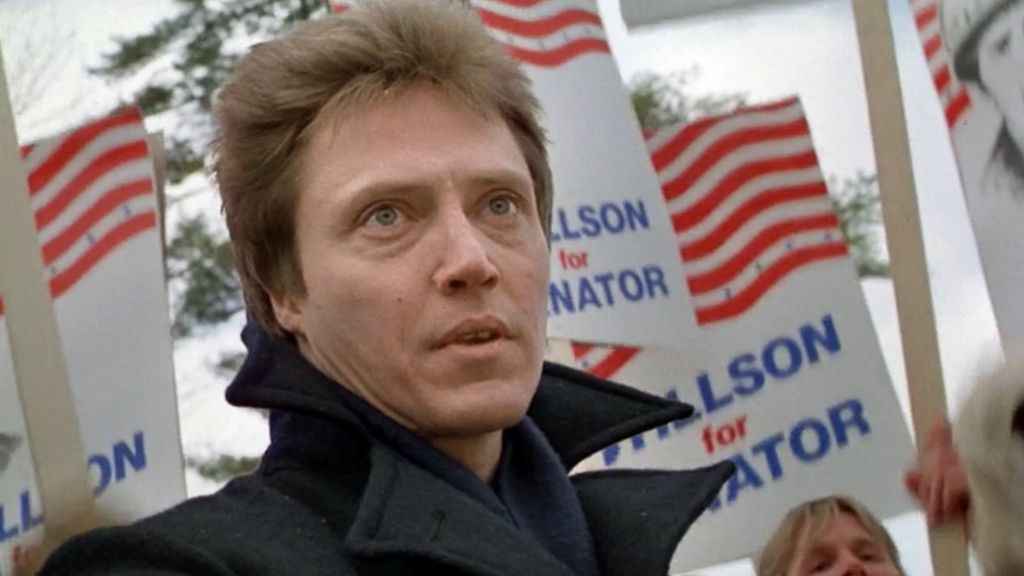
The Dead Zone (1983) remains startlingly relevant with its portrayal of a charismatic populist politician whose rise to power threatens apocalyptic consequences. Through Christopher Walken’s tormented psychic, we witness the horror of foreseeing disaster but being powerless to convince others of the impending doom.
Red State (2011) savagely deconstructs religious extremism in America, following a hateful church congregation that mirrors real-world hate groups. The film’s strength lies in showing how easily religious doctrine can be twisted to justify atrocity while law enforcement agencies become complicit through inaction or incompetence.
Civil War (2024) imagines the ultimate consequence of American political division, depicting a nation torn apart by ideological extremes. While not strictly horror, its unflinching portrayal of neighbor turning against neighbor captures a terrifying possibility that feels increasingly less like fiction.
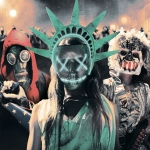
The Purge (2013) envisions a dystopian America where all crime, including murder, is legal for one night per year. The film serves as a chilling allegory for the ways in which the wealthy and powerful can exploit legal loopholes to maintain their dominance and target the most vulnerable members of society.
The Hunt (2020) takes the premise of “The Most Dangerous Game” and infuses it with a scathing critique of partisan politics in America. The film’s depiction of liberal elites hunting conservative “deplorables” serves as a savage indictment of the dehumanization and demonization of political opponents.
La Llorona (2019) brilliantly reimagines the Latin American folk tale as an indictment of genocide and governmental oppression. Set in Guatemala, it follows a military dictator facing supernatural revenge for his crimes against indigenous peoples, drawing clear parallels to modern immigration policies and systemic racism.
The Platform (2019) uses its vertical prison setting as a brutal metaphor for class warfare and resource inequality. While Spanish in origin, its critique of “trickle-down” economics and social hierarchy resonates strongly with American capitalism’s darker aspects.
Train to Busan (2016), while Korean, offers a devastating critique of class privilege and social responsibility that translates perfectly to American society. Its zombies serve as catalysts, revealing how quickly social bonds dissolve when resources become scarce.
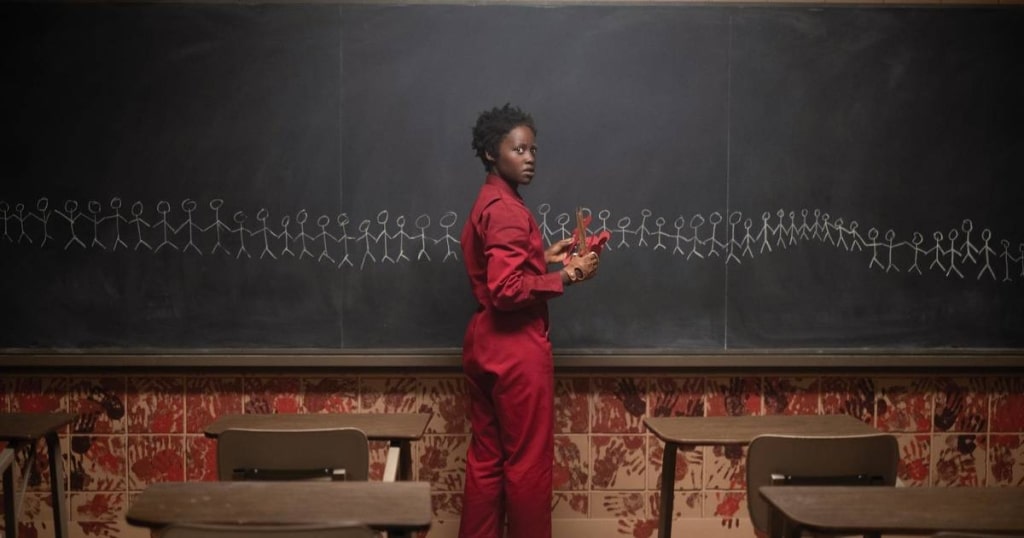
Us (2019) masterfully explores American class divisions through the metaphor of the “tethered” – underground doubles of surface dwellers. Jordan Peele’s film forces viewers to confront uncomfortable truths about who we consider “worthy” of the American dream and the hidden costs of our comfort.
The Devil’s Backbone (2001) uses a ghost story set during the Spanish Civil War to explore how societies create “others” during times of conflict. Its themes of betrayal, innocence lost, and institutional corruption speak directly to contemporary American politics.
His House (2020) is a haunting immigration story that uses supernatural elements to explore the refugee experience. Through its ghostly premise, “His House” confronts the viewer with the harsh realities of the refugee crisis, the lasting trauma of displacement, and the ways in which systemic racism and xenophobia can haunt marginalized communities even in their supposed places of refuge.
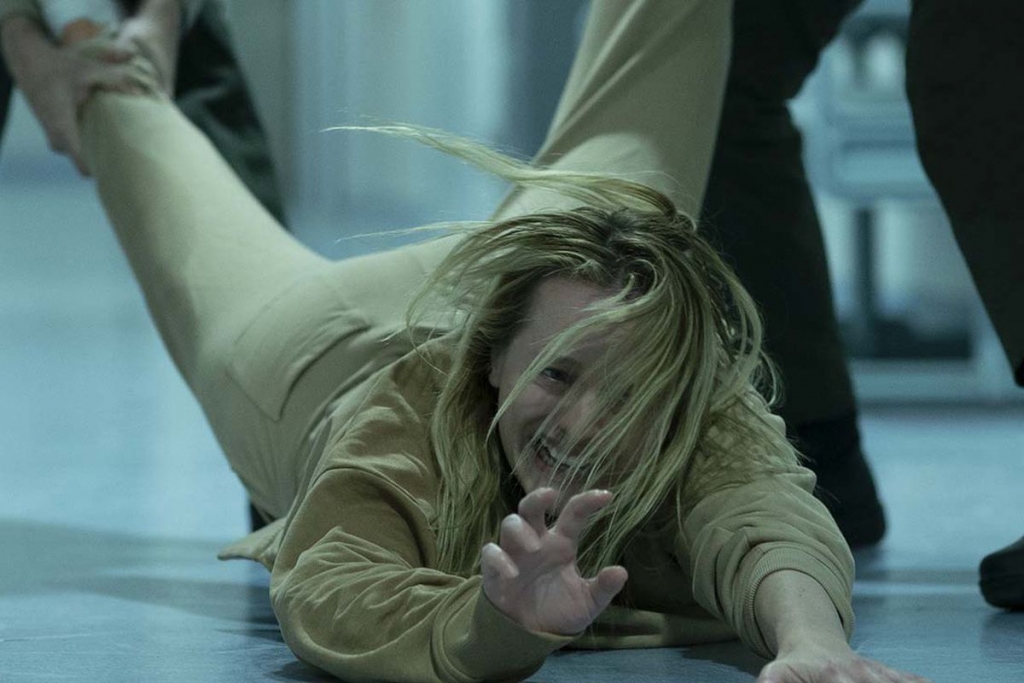
The Invisible Man (2020) updates H.G. Wells’ classic story into a haunting allegory for domestic abuse and gaslighting. Elisabeth Moss’s character faces not just her tormentor but also the systemic disbelief of women’s experiences by authorities and society at large.
Rosemary’s Baby (1968) remains a devastating critique of patriarchal control over women’s bodies and choices. Its themes of bodily autonomy and religious authority’s role in controlling women are perhaps even more relevant today than when it was released.
The Witch (2015) is a chilling exploration of patriarchal oppression and female agency in Puritan New England. Its slow-burning descent into darkness parallels the gradual erosion of a young woman’s autonomy within a repressive religious community.
Jennifer’s Body (2009) subverts the traditional “Final Girl” trope by centering on a teenage girl who, after a satanic ritual, becomes a flesh-eating demon. Directed by Karyn Kusama, the film is a darkly comedic exploration of female sexuality, high school social dynamics, and the objectification of women.
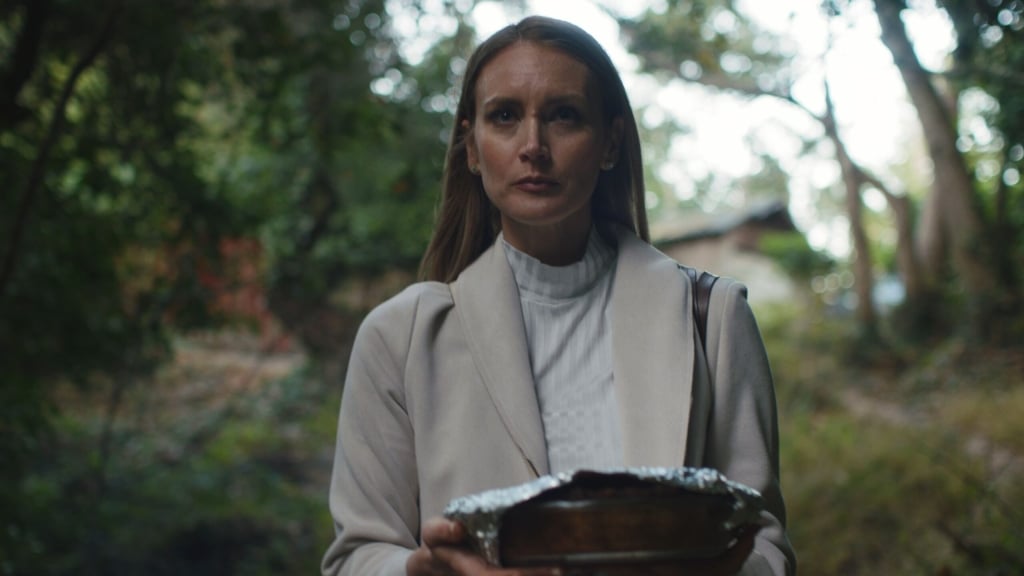
Soft & Quiet (2022) presents a chilling portrayal of everyday white supremacy, following a group of seemingly “normal” women whose casual racism escalates to violence. Its real-time narrative structure creates an unbearable tension while forcing viewers to confront how hatred can hide behind polite smiles.
Green Room (2015) brings white supremacist violence into sharp focus through the siege of a punk band by neo-Nazis. The film’s power lies in showing how such extremist groups operate in plain sight while maintaining connections to legitimate power structures.
The Invitation (2015) explores how grief and trauma can make people vulnerable to manipulation by cults and extremist ideologies. Its slow-burn approach mirrors the gradual way rational people can be drawn into dangerous groupthink.
Speak No Evil (2022) examines the paralysis of political correctness and the fear of confrontation that can enable evil to flourish. Although a Danish film (the original, not the recent American remake), its exploration of social cowardice resonates strongly with American political discourse.
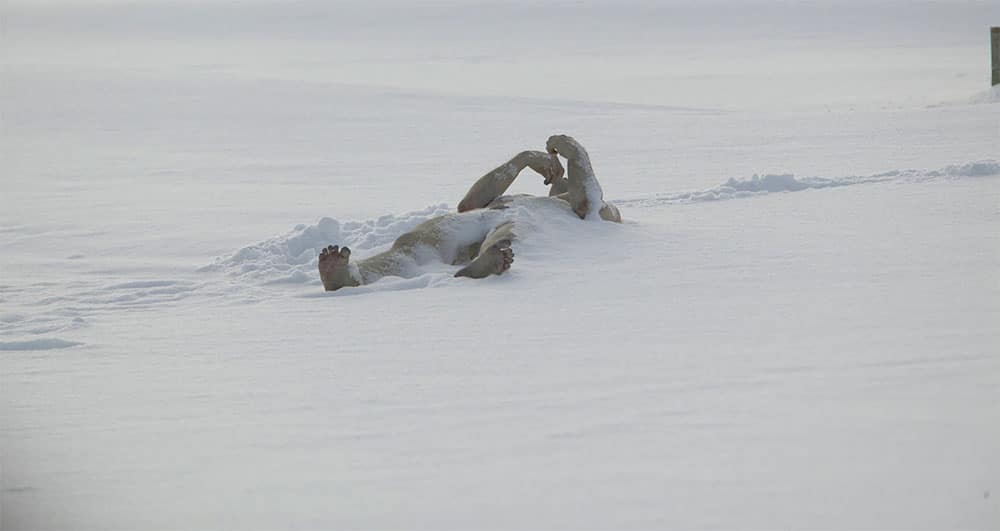
The Last Winter (2006) presents environmental destruction as cosmic horror, suggesting that nature itself might rise up against human exploitation. Its themes of corporate greed versus environmental responsibility feel increasingly prescient.
God Bless America (2011) takes aim at American culture’s celebration of cruelty and ignorance through a dark comedy that borders on horror. While satirical, its critique of media-fueled social decay cuts deep.
The Ruins (2008), while ostensibly about ancient Mayan curses, can be read as an allegory for American interventionism and the consequences of cultural arrogance.
The Vast of Night (2019) blends elements of science fiction and horror to craft a meditative exploration of the power of rumor, conspiracy theories, and distrust in American society. Its slow-burn approach creates an unsettling atmosphere that lingers long after the credits roll.
…
These films serve as more than entertainment; they’re canaries in the cultural coal mine, warning us about the consequences of our societal choices. They remind us that the most terrifying monsters aren’t supernatural creatures but the darkness that lurks within human nature: our capacity for hatred, our willingness to demonize others, and our ability to justify cruelty in the name of ideology.
The power of horror cinema lies not just in its ability to frighten but also in its capacity to force us to confront uncomfortable truths about ourselves and our society. As America grapples with deepening divisions and social challenges, these films become more than cautionary tales—they become mirrors reflecting our worst possibilities and, perhaps, if we heed their warnings, maps to help us avoid our darker futures.

She’s a lover, he’s a fighter. Together, they’re CHEER AND LOATHING. Tune in to hear your hosts, Stephanie (Cheer) and Casey (Loathing), clash over the films they love — and the ones they love to hate.
In this holiday extravaganza episode of Guilty Pleasures, join hosts Stephanie, Kelly, and our newest addition, Jonathan (Jack was tied up in tinsel and couldn't join us), as they unwrap the bizarre and unhinged world of holiday cinema. They dive into the depths of Elves, a film that's as chaotic as it is entertaining. It's a sleigh full of questionable decisions, diabolical dialogue, absurd plot twists, wildly offensive antics, and unhinged holiday mischief.
And that's not all! In the second half of the podcast, join your festive cinephile friends for a look at four more ”nutty as a fruitcake” holiday treats: A New York Christmas Wedding, Elf Bowling, A Medea Christmas, and Jack Frost. Plus, we each offer a bonus Christmas flick guaranteed to make you say, ”Ho, Ho, HO-LY Hell!”
Expect laughter, disbelief, and a spirited debate about what truly makes a movie a guilty pleasure. Don't miss this festive journey through the weirdest corners of holiday films!


Follow Us!